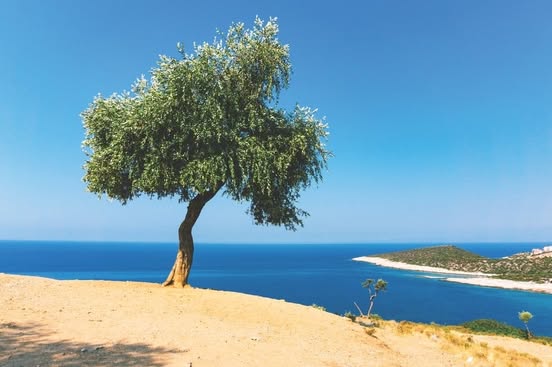
In Greece, but also generally throughout the Mediterranean region, the olive tree is one of the most important trees. From ancient times until today, Greeks have cultivated olive groves and enjoyed their fruit — the olives — and the oil that comes from them, olive oil, which is a fundamental part of the Mediterranean diet.
A Little History
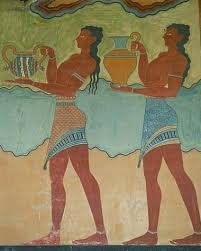
In the Greek region, wild olives were collected as early as the Neolithic period. According to Homer, the olive tree had been cultivated in Greece for over 10,000 years. Crete is considered the probable center of its domestication. The cultivation of the olive tree and the trade of olive oil in Crete during the Minoan period (3000–1000 B.C.) were extensive and formed a key factor in the island’s economic prosperity. Discoveries such as oil storage jars in Knossos and parts of an olive press in Phaistos confirm this activity. In ancient Greece, athletes in the Olympic Games were crowned with olive branches, called
κότινος, and olive oil was used in religious ceremonies, in cooking, and for body care. Even today, the olive tree remains a symbol of peace and victory.
During the Roman era, the Romans helped spread olive cultivation across all territories of their empire. Trade flourished, with Roman ships distributing large quantities of oil to areas lacking production.
In the Byzantine era, olive oil production in Greek lands was of vital importance, as the empire included half of the world’s productive regions and exported the product worldwide. Production was not affected during the 14th–17th centuries, preserving the traditional Greek way of life and gaining a special place in the Orthodox Christian Church as a symbol of love
and peace, essential in religious ceremonies such as baptism and in church lamps. From then until today, Greece has become a global exporter of high-quality olive oil. The Greek farmer’s deep respect for the olive tree is passed down through generations, along with the custom of planting an olive tree at the birth of a child — a tree that grows with th
child and continues to bear fruit for future generations.
The Harvest Season
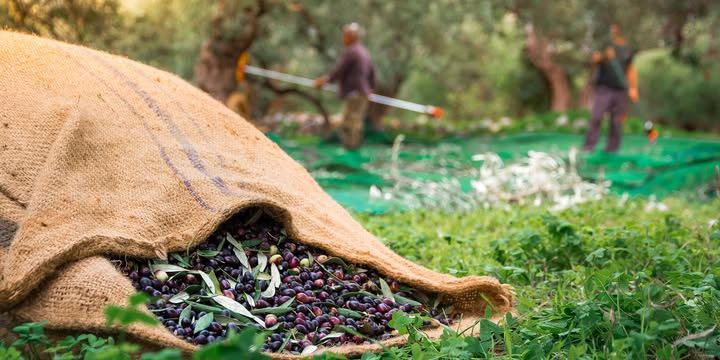
The olive harvest begins in October and continues until January. People collect olives by hand or by striking the branches with sticks or special tools. The olives fall and are gathered on nets spread around the tree. At the end, they are placed in crates and taken to the olive press, where the fresh olive oil is produced. The harvest season is a tiring but also beautiful
time. You can see the procedure of harvesting olives from start to finish in our video.
Expressions with “Olive” and “Oil”
In the Greek language, there are many expressions that include the words olive and oil, such as:
● «Εριξε λάδι στη φωτιά» – meaning he made the situation worse.
● «Του έβγαλε το λάδι»/«Μου βγήκε το λάδι» – the first means he exhausted him; the second means “I got very tired.”
● «Η θάλασσα είναι λάδι» – meaning the sea is calm, without waves.
● «χάνει λάδια» – said about someone who isn’t acting rationally, or something that isn’t working properly.
Also, the verb λαδώνω (“to oil”), besides its literal meaning, also means to bribe. Example: Λάδωσε για να πάρει το δίπλωμα οδήγησης./He bribed someone to get his driver’s license.
Conclusion
The olive tree is not just a tree. It is a symbol of Greece, of peace, of life, and of our land. Every drop of olive oil carries within it the history, the sun, and the soul of Greece.
If you enjoyed this story and wish to dive deeper into Greek language and culture, book your free trial lesson with us and start your journey today!
Ta leme!